There and back again, or why I switched back to iPhone
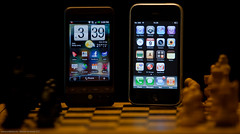
Image by nrkbeta via Flickr
I saw the original iPhone keynote in person, and stood in line the day it came out. Shortly thereafter, I joined the Android team as a product manager. Over the last few years, I've used several prototypes, a Nexus One, and finally a Nexus S. A couple of weeks ago, I switched back to an iPhone 4S.
Long story short, I love being back on iPhone. Android has made impressive progress over the years, and today's best Android devices are competitive – even better in some areas. Despite this, the iPhone still provides the best experience overall.
Below, I go into some details on my experience using each platform.
Where the iPhone shines
- Hardware. The iPhone 4/4S physically feels much nicer than any Android phone I've owned. Between the simple shape, the choice of materials (glass and metal instead of plastic) and Apple's exacting manufacturing process, it feels like a single, solid slab. Incidentally, I'm not entirely unhappy to have skipped the plastic-backed 3G/3GS.
- Screen. The screen is gorgeous, web pages look super crisp. The Nexus S had an excellent display, but this one is visibly better. I'll take this over a lower quality 4 inch screen any day.
- Camera. The camera in the 4S is so good that I'll never get a point and shoot again. It's fast, the picture quality is great, and Instagram makes it easy and fun to share pictures. Because of this, I use the camera 10x more often than I did on Android.
- Consistent navigation. The premise behind Android's physical buttons was to simplify navigation through consistent access to home, search, back and menus. In practice, navigation is much simpler on my iPhone. Every in-app action is clearly visible on the screen at any given time, and iOS provides smooth app-switching mechanisms (home button, double click).
- Better apps. While it's true that most popular apps are available on both platforms, the iPhone versions are often shockingly better. They are released first, updated sooner, and generally better designed. I've found this to be true for Spotify, Foursquare, and many others. Furthermore, many games and new apps are only available on iOS.
What I miss most from my Android
- Navigation. I have a car, so I used Google Maps Navigation quite a bit, and it's amazing. In comparison, following directions in iOS is super frustrating. There's a business reason for this*, and word on the street is that Apple is building its own mapping solution, but Google has a huge head start.
- Deep Google Voice integration. I grew up in France, so I frequently make international calls. On Android, whenever I dialed an internation number, it automatically switched to Google Voice ("...this call is 2¢ per minute..."). On iPhone, I have to remember to use the separate Google Voice app.
- Intents. This is Android's clever mechanism for linking applications together. For example, when I shared a picture from the Android gallery, I could pick which application to share with (Facebook, Twitter, Instagram, etc). On iOS, I'm stuck with the options that the OS gives me (say Twitter but not Facebook). This is a simple and elegant system, and I hope Apple adopts something similar.
- Automatic updates. On Android, applications updated automatically most of the time (unless their permissions had changed). On iOS, I have to check the App Store, then manually approve the update. This feels unnecessary, given that I always choose "update all". In fact, I'd go one step further and update silently, like Google Chrome.
Other thoughts
- The notifications on Android and iOS are now quite similar. The one big difference is that Android notifications persist in the status bar. For me, iOS' app badges are a better solution for important notifications. As for the rest, I'm happy to have them out of the way (even if it means cleaning out the notifications drawer now and then).
- The iOS keyboard has always worked better for me than the Android one. The one thing I miss is Android's clever apostrophe corrections ("il" for "I'll", "wer" for "we're"). I find iOS' heuristic approach less reliable, but it's a lot more discoverable for the average user.
- Syncing thousands of contacts causes issues on each platform. Android synced seamlessly with both Google and Facebook. However, the performance was horrible - looking up a contact would routinely take several seconds. iOS performs beautifully, but it's harder to set up, and, more worryingly, I seem to have lost some contact information in the sync. These are nasty bugs on either side.
- Siri is very fun to use, and I find that I use it more often than voice commands on Android (mostly for simple things like settings alarms). The contextual awareness makes a big difference, as does the cute personality. This being said, Siri still fails me quite often, and the fact that it can't handle third party applications (like Spotify for music) limits it even further.
- It's not installed by default, but Apple's Find My Friends app is really useful. I'm sure there are similar apps on Android, but none that are as simple to use (this is so much better than Google Latitude). I only wish it had some support for non-iPhone users (a web view, for example).
- Because I had an unlocked Nexus S, I could use it as a mobile hotspot for free. I didn't use it frequently enough to justify a $30 price premium, but it sure was a nice perk.
Parting thoughts
At the end of the day, Android and iOS both provide incredible experiences. Compared to my first phone, a Motorola Razr, it's hard to believe how far we've come.
I feel strongly that the iPhone is the best phone in the world. But I'm convinced that the iPhone wouldn't be as good as it is if it weren't for Android's competition, and I'm excited to see what amazing improvements they both deliver to us next.
I'll leave you with Microsoft's Future Vision 2011 video. As far as I'm concerned, that future is already here:
* Licensing map data from Navteq or TeleAtlas is much more expensive for turn-by-turn (~$10/user) than for directions (~$1/user). Google got around this by creating their own maps from scratch (!) using Street View data. For the time being, it seems that keeping this feature as a competitive advantage for Android outweighs whatever Apple is willing to offer for it. Not to mention that today Apple makes $15 for every user that purchases a $50 navigation app in the App Store.
